
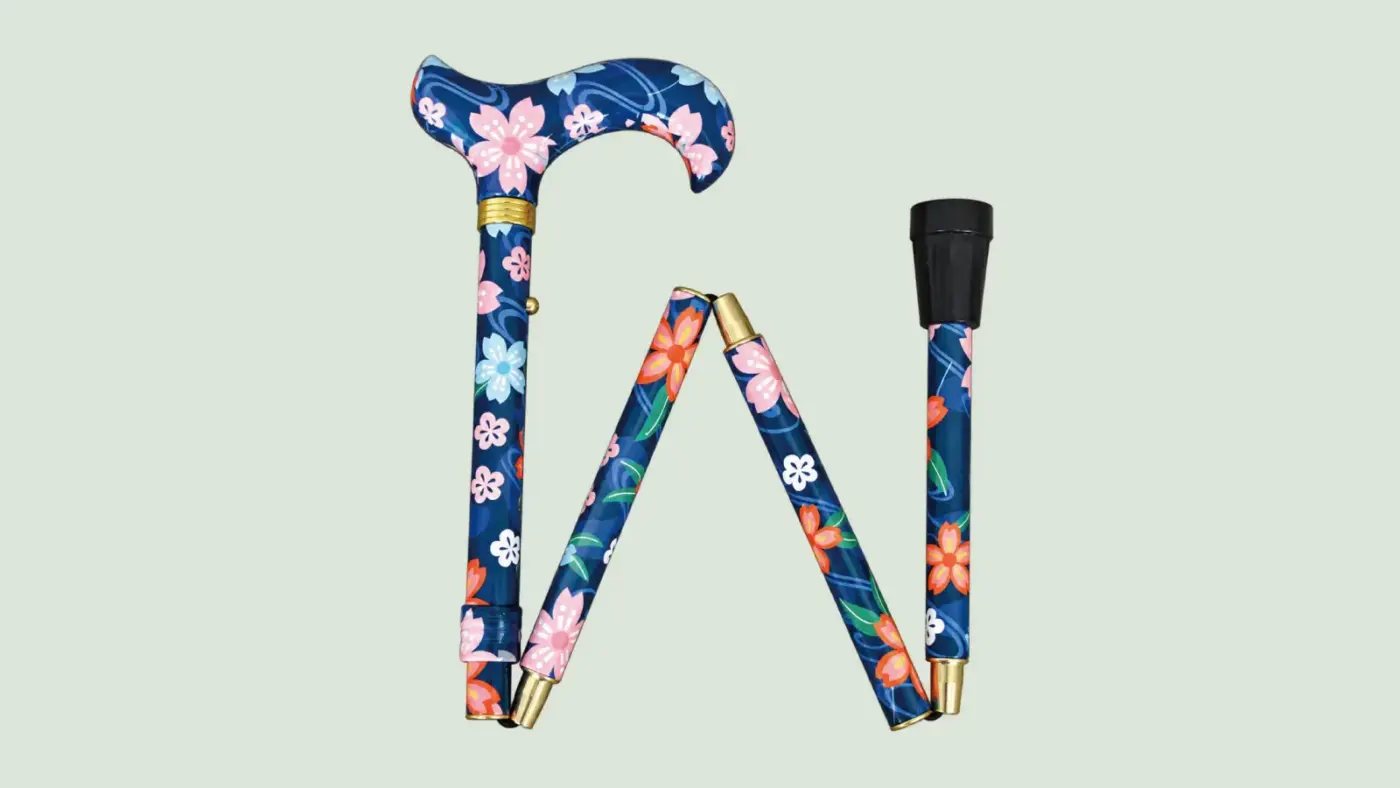
Folding Adjustable Walking Cane: From CNC Joints to a Maple Handle
Choosing a walking cane involves both practical support and personal acceptance. For older adults, fall prevention also depends on physical ability and the surrounding environment; a cane’s appearance, grip, and ease of operation can influence whether the person feels comfortable using it in daily life.
A folding adjustable walking cane combines compact storage with height adjustment. To assess it properly, look beyond color and folded length to the joints, tubing, handle, locking mechanism, and rubber tip.
DEERMED is a Taiwan-based walking cane and walking stick manufacturer. Using the design described below, this article explains ten material and manufacturing details—and what each detail can and cannot tell you about the finished product.
What Is a Folding Adjustable Walking Cane?
A folding adjustable walking cane has two separate functions: the shaft folds for storage, while a telescopic section adjusts the handle height. A compact folded size does not automatically mean the available height range will fit every user.
The design featured here folds into four sections and offers five height settings. “Five settings” refers to the available heights, not five folding shaft sections.
Specifications of the Featured Design
The following specifications apply to the design discussed in this article. They should not be assumed to apply to every folding cane in DEERMED’s range.
| Component or Feature | Specification |
|---|---|
| Shaft material | Precision-drawn 6063 aluminum alloy tubing |
| Folding joints | CNC-machined aluminum alloy joints |
| Height adjustment | 80–90 cm, with five settings |
| Folded length | Approximately 28 cm |
| Upper tube outside diameter | 19 mm |
| Lower tube outside diameter | 16 mm |
| Tube wall thickness | 1.25 mm |
| Handle | Canadian maple |
| Decorative neck collar | Brass with 22K gold plating |
| Wrist strap | Woven nylon |
| Height-adjustment collar | Textured aluminum tightening collar |
| Ground-contact tip | Rubber |
| Shaft decoration | Decorative transfer printing |
Before ordering, confirm the exact configuration, intended use, and stated user weight limit for the supplied model. Tube dimensions alone do not establish a finished-cane load rating.
Shaft and Joints: Three Details Behind the Construction
Joint fit depends on the connecting parts, tube dimensions, and assembly working together. No single alloy designation or machining method provides a complete assessment of the cane.
1. CNC-Machined Aluminum Joints
This design uses separately machined aluminum alloy joints to connect the folding sections. The manufacturing focus is on mating dimensions and clearance so that the sections can seat fully and be separated for folding.
The fit must balance two needs:
Sufficiently controlled clearance when assembled.
Manageable assembly and folding for the user.
An excessively tight connection can be difficult to operate, while an excessively loose connection may produce unwanted movement.
Another construction method forms the connection directly from expanded or reduced tube ends. The distinction is how the joint is made, rather than an automatic verdict on the finished cane.
| Comparison | CNC-Machined Joints | Formed Tube-End Connections |
|---|---|---|
| Construction | Separate machined parts assembled with the tubing | Tube ends shaped to create mating connections |
| Production focus | Joint dimensions, clearance, and assembly | Tube-end dimensions, forming quality, and fit |
| Practical check | Full seating and smooth assembly | Full seating and smooth assembly |
| Performance evidence | Finished-product specifications and testing | Finished-product specifications and testing |
CNC machining does not mean a joint will never wear. A durability comparison requires finished products tested under comparable conditions.
2. Precision-Drawn 6063 Aluminum Tubing
The featured shaft uses precision-drawn 6063 aluminum alloy tubing. Consistent tube dimensions matter because the tubing must work with both the folding joints and the height-adjustment section.
“6063” identifies the aluminum alloy; it is not a load rating. Finished-product performance also depends on tube diameter, wall thickness, material condition, joint design, and assembly.
For sourcing decisions, ask for clear specifications rather than relying on descriptions such as “aircraft-grade” or “high-strength” without supporting detail.
3. Tube Diameter and Wall Thickness
This design has a 19 mm upper tube, a 16 mm lower tube, and a wall thickness of 1.25 mm. These dimensions describe the tubing but cannot be converted directly into a safe user weight limit.
Larger or thicker tubing is not automatically more suitable for every person. The complete design must also account for weight, folded bulk, and ease of handling.
Check whether:
The intended use and user weight limit are clearly stated.
The shaft is free from bends, dents, and cracks.
Every folding joint seats fully.
The height-setting mechanism holds correctly.
The intended user can manage the assembly and storage process.
Handle and Operating Components: Five Everyday Details
The handle, strap, tightening collar, and tip affect everyday handling. The decorative neck collar contributes to the appearance, and its role should be distinguished from the height-adjustment mechanism.
4. Canadian Maple Handle
The Canadian maple handle provides natural wood grain and a wooden contact surface. Comfort still depends on the handle’s shape, size, finish, and fit with the user’s hand.
A material preference is a valid part of choosing a cane. However, a wood handle should not be assumed to suit every hand or to resolve pain.
When trying the handle, observe whether:
The palm rests naturally on the supporting surface.
The fingers need to grip excessively.
The wrist is forced into an awkward position.
Pressure, pain, or numbness develops during use.
Persistent discomfort calls for a review of the handle, cane height, and technique.
5. Brass Neck Collar with 22K Gold Plating
The decorative collar is made from brass, CNC-machined, mirror-polished, and finished with 22K gold plating. It provides a metal accent between the maple handle and the shaft.
Gold plating describes the surface finish; the underlying collar remains brass. Wear, cleaning methods, and the environment can affect its appearance.
The collar’s finish should not be presented as evidence of greater load capacity or permanent resistance to fading.
6. Woven Nylon Wrist Strap
The woven nylon strap helps with managing the cane in appropriate situations, but it is not a support sling for the body. Check the weave and attachment point for damage or loosening.
Material names alone do not establish the service life of every strap. Construction, fastening, friction, and use conditions also matter.
If the strap catches on doors, furniture, or clothing, reconsider how it is being used.
7. Textured Aluminum Tightening Collar
The height-adjustment collar has pronounced grip texture to help the fingers turn it. Whether it is easy to operate should still be assessed by the intended user.
The positioning button and tightening collar have different roles. The button must project fully through the selected adjustment hole before the collar is tightened according to the instructions.
Tightening the collar cannot compensate for a button that has not engaged. If the user cannot complete the sequence reliably, arrange assistance or consider a different configuration.
8. Rubber Tip
The rubber tip forms the contact point between the cane and the ground. Its practical grip depends on condition, placement, and the surface beneath it.
Wet tiles, oil, algae, loose gravel, and soft ground can all change the support available. A tip may need replacement if it is worn smooth, split, hardened, or loose.
South Tees Hospitals NHS Foundation Trust advises regular checks of the rubber feet, tubing, adjustment holes, locking clips, and handles. [1]
Storage and Appearance: Two Features to Match to Daily Life
Folding and decorative finishes address different needs: portability and personal style. Their value depends on how the cane will actually be carried, stored, and used.
9. Four-Section Folding and Five Height Settings
The featured cane folds to approximately 28 cm and adjusts from 80 to 90 cm across five settings. Folded length concerns storage; the height range concerns fit.
A cane may fit in a bag yet remain too tall for its user. Conversely, the height may be appropriate while the unfolding process is difficult to manage.
Before choosing a bag, check the handle width and folded thickness as well as length. During a short rest, keep the cane where it can be reached safely rather than automatically packing it away.
10. Decorative Transfer Printing
The featured shaft uses decorative transfer printing to create colors and patterns. DEERMED can discuss custom patterns and OEM/ODM development according to the project requirements.
For users, a preferred pattern can help the cane feel consistent with personal style. For brands, it can contribute to a coordinated product range.
Confirm the appearance through samples, including:
Color and contrast.
Pattern placement and orientation.
The relationship between the shaft, handle, and metal details.
Any proposed logo or packaging treatment.
Do not assume the finish is permanently fade-proof or scratch-proof. Available effects and production requirements should be confirmed for the selected configuration.
How Should You Choose Beyond Materials and Price?
Choose a cane by its fit, operation, and support requirements before comparing decorative details. A higher price, more components, or a premium finish does not automatically make a cane more appropriate.
A useful decision sequence is:
Confirm that a single-tip cane provides the type of support needed.
Establish the required handle height.
Check whether the user can unfold and inspect the joints.
Try the handle and complete weight.
Review the intended use, stated limits, and instructions.
Confirm replacement tips and after-sales contact options.
If folding is rarely needed, a non-folding adjustable walking stick may be a practical alternative. Extra functions are useful when they address an actual need.
How Do You Adjust and Check This Cane Before Use?
Complete the joint, height, and locking checks before relying on the cane for support. Sit securely or use another reliable source of support while making adjustments.
For this design:
Unfold the shaft under control and check that every joint is fully seated.
Remove all support load from the cane.
Loosen the height-adjustment collar.
Press the positioning button and move the inner tube to the required setting.
Confirm that the button projects fully through the selected hole.
Tighten the collar according to the instructions.
Confirm that the inner tube does not slide and recheck the folding joints.
Try a short walk on a dry, level surface with appropriate assistance.
MedlinePlus gives wrist-level handle height and a slight elbow bend as general fitting references. Individual posture or rehabilitation requirements may require a different assessment. [2]
Does the Cane Need to Stay Vertical While Walking?
A cane’s angle changes during a normal step; it does not need to remain perfectly vertical throughout walking. The tip should be securely placed before support force is applied.
For a weaker leg, general guidance is to hold the cane in the opposite hand and advance it with that leg. Follow individual clinical instructions when surgery, weight-bearing restrictions, or upper-limb limitations affect the technique. [2]
When Might a Single-Tip Folding Cane Be Unsuitable?
A single-tip cane may be insufficient when someone needs more than limited assistance with balance or stability. A different aid or professional assessment may be needed instead of a thicker shaft or another material. [2]
Seek advice from a doctor, physical therapist, or occupational therapist when there are:
Repeated falls or near-falls.
Difficulty standing safely without assistance.
Substantial weakness or reliance on the cane.
Postoperative weight-bearing restrictions.
Persistent instability, pain, or numbness during use.
This design is intended for everyday walking assistance and should not be treated as a trekking pole. Stop using it if joints separate, tubing deforms, the handle loosens, or the height lock fails.
This article provides general product information and does not replace individual medical, rehabilitation, or walking-aid assessment.
DEERMED’s View: Make Manufacturing Details Useful to the Buyer
Manufacturing details matter when they lead to clear specifications, manageable operation, and connections the user can check. Appearance belongs in the decision too, alongside height, construction, and support needs.
Users and families can begin by confirming the required height and trying the handle, unfolding process, and walking feel.
Brands and distributors can begin with the target user, sales market, dimensions, and desired appearance. Those requirements provide a clearer starting point for discussing samples and production.
Explore DEERMED’s folding walking cane range or contact DEERMED about product specifications and OEM/ODM development.
Frequently Asked Questions
Beyond materials and manufacturing, buyers often need to confirm bag fit, height options, replacement parts, and customization requirements. These answers apply to the featured design; always check the instructions and specifications for the exact model supplied.
Will a folding cane measuring approximately 28 cm fit in a handbag?
Not necessarily. Approximately 28 cm describes the folded length, but the handle width, folded thickness, bag opening, and usable internal space also affect fit.
Ask for the complete folded dimensions and compare them with the bag you intend to use. Check that the cane can be removed easily when needed, rather than requiring force or extensive searching.
What if I need a folding walking cane outside the 80–90 cm height range?
Ask DEERMED whether another model or a size modification can be evaluated. Do not assume that the standard design can accommodate a height outside its stated range.
Provide the required handle height and any relevant fitting information. Do not drill extra holes, cut the tubing, or reduce joint engagement yourself. Where posture or postoperative restrictions affect fit, obtain professional advice first.
Can I use the cane as soon as the elastic cord pulls the sections straight?
No. Check every folding joint for full engagement, then confirm the height-setting button and tightening collar before applying support force.
The internal cord connects and guides the sections; a straight-looking shaft does not prove that each joint is correctly seated. If the cord becomes loose, frayed, or damaged, contact the original supplier rather than tying a knot or installing an ordinary replacement cord.
Can I use a universal 16 mm replacement rubber tip?
A 16 mm label alone does not confirm compatibility. Although this design has a 16 mm lower tube outside diameter, the replacement tip must also have suitable internal dimensions, insertion depth, and fastening characteristics.
Provide the cane model and photographs of the shaft end to the supplier. Do not use a tip that remains loose, sits at an angle, or cannot be fitted fully, and do not use tape to compensate for an incorrect fit.
Do the maple handle and gold-plated collar need special polish?
Follow the care instructions for the actual finishes. Do not apply wood oil, furniture wax, or metal polish simply to increase shine.
A soft, dry cloth can be used initially to remove dust and fingerprints. Ask the supplier before using additional cleaning products. Keep the handle dry and controllable, and report splinters, peeling finish, loosening, or unusual collar movement.
What should a brand prepare for a custom folding walking cane inquiry?
Provide the company or brand name, target market, estimated quantity, and proposed customization. Reference images or artwork are useful, along with any specified colors, logo positions, and packaging requirements.
Minimum quantities, sample charges, and lead times depend on the scope and should be confirmed for the project. Approve samples before production, and assess changes to handles, joints, or other structural components separately from decorative changes.