
Where to Keep a Walking Cane at Home: Bedside, Chair, and Entryway Tips
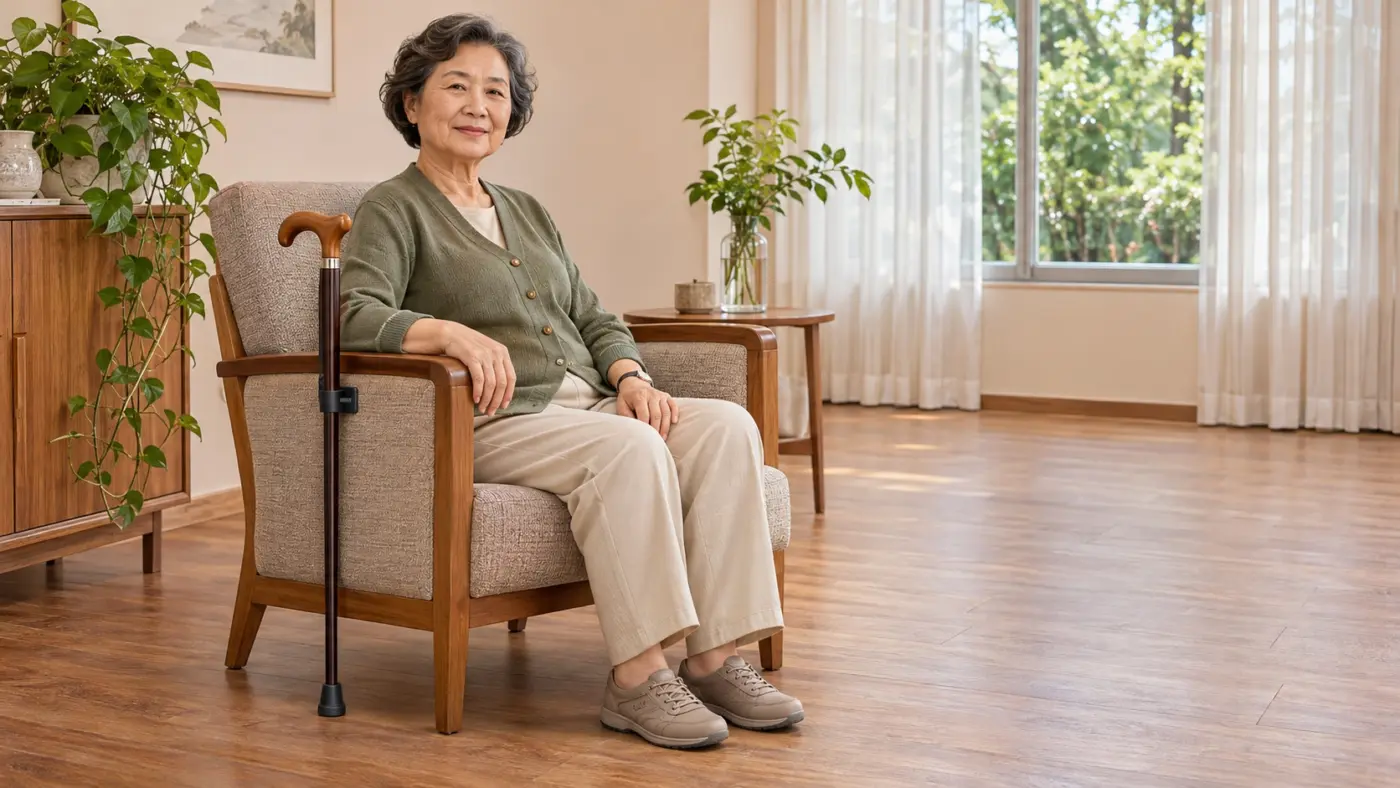
For older adults who use a walking cane, fall prevention involves both personal mobility and the home environment. Acceptance matters too: a cane should have a natural place in daily life, rather than being hidden away because someone feels it makes the room look too medical.
The best place to keep a walking cane is a consistent, accessible spot where it rests securely without blocking movement. The key question is simple: when the person next needs to walk, can they obtain the cane without an awkward reach or an unsupported journey to find it?
This is different from storing an occasional accessory. A cane beside a chair may look tidy but still be difficult to retrieve. A cane near the bed may be close to the hand while its base occupies the exact place where the user needs to put their feet.
Four Principles for Walking Cane Placement
A suitable location should be predictable, accessible, secure, and clear of the walking route. All four conditions matter; proximity alone does not make a location suitable.
Keep the Location Consistent
The user, family members, and caregivers should know where the cane belongs after use. Moving it between corners, cupboards, and doorways makes the next movement less predictable.
Agree on a usual resting point near the places where the person regularly sits or prepares to walk. A designated spot does not necessarily require new equipment—it requires a clear arrangement that everyone follows.
If cleaning makes it necessary to move the cane, return it to the agreed location before leaving.
Make It Accessible Before Walking
A person who needs a cane for walking should not have to walk without the required support to reach it. Check access from the actual bed or seat, rather than judging distance while standing elsewhere in the room.
Ask:
Is the cane available when the person is ready to move?
Does retrieving it require leaning far forward or twisting behind the seat?
Must the person walk around furniture before reaching it?
Can it be taken from its holder without pulling hard or losing balance?
If someone regularly walks along walls or furniture to collect their cane, review both the placement and whether their current walking aid meets their needs.
Choose a Secure Resting Method
A cane that repeatedly slides to the floor needs a different resting arrangement. Repeatedly retrieving it creates an unnecessary task, and the fallen shaft may obstruct the next step.
Depending on the cane and the room, consider:
A compatible holder or stand that remains stable during removal.
A secure hanging arrangement that does not require an awkward reach.
A self-standing base used according to the product instructions.
Another designated location that has been checked for reliable access.
A cane holder keeps the cane in place; it should not be treated as a handhold for standing. Likewise, a wheeled table or movable chair should not become a transfer support simply because it is nearby.
Keep Feet, Doors, and Routes Clear
The cane and its base should remain outside the space needed for foot placement, turning, and the first step. A location can be within reach and still create an obstacle.
Check door swings, furniture corners, and the path between the seat and the next destination. Include the full footprint of a multi-foot base rather than looking only at the shaft.
How Does Placement Differ Around the Home?
Bedside, chair-side, and entryway placement follow the same principles, but each must accommodate different movements. Arrange the cane around what the person actually does in that space.
| Location | Main Activity | Placement Priority | Common Problem |
|---|---|---|---|
| Beside the bed | Sitting at the edge, standing, and starting to walk | Accessible from the usual exit side, outside the foot-placement area | Cane under the bed or base beside the feet |
| Beside a chair or sofa | Sitting down, standing, and turning | Available without reaching across furniture | Handle wedged between cushions or cane leaning on a movable table |
| Entryway | Changing shoes, handling belongings, and opening the door | Near the routine but outside the doorway | Cane behind the door or tangled with umbrellas |
There is no universal distance or left-or-right rule. Furniture layout, reach, transfer ability, and the person’s prescribed technique affect the final position.
Where Should You Keep a Cane Beside the Bed?
Keep the cane near the side normally used to get out of bed, with the handle accessible and the base clear of where the feet land. Check the position from the bed edge, not only while lying down.
Taiwan’s Health Promotion Administration recommends providing a bedside place for a cane or walker, together with accessible lighting. [1]
Review the normal sequence:
Identify the side used to leave the bed.
Check where the feet are placed when sitting at the edge.
Confirm that any required transfer support is suitable and secure.
Arrange access to the cane without stepping away to find it.
Keep the first walking step clear of the cane base and nearby objects.
A bedside cabinet is not automatically the best location. If it puts the handle behind the user’s shoulder, a closer-looking position may still require an awkward twist.
Do Not Use the Cane as a Fixed Bedside Rail
A walking cane is not an anchored rail for pulling the body out of bed. If standing requires substantial pulling or another person lifting the user, the transfer method needs assessment.
Follow the technique taught by the person’s healthcare professional. Any proposed bed rail or transfer aid should be assessed for that person and bed, rather than added solely because a support seems convenient.
Make Nighttime Access Visible
The cane’s location should be easy to identify under the lighting actually used at night. Knowing where it belongs is not enough if the handle, base, or surrounding obstacles cannot be seen.
Check:
Whether the light can be switched on without an unsafe reach.
Whether bedside and route lighting are adequate.
Whether clothing, cords, or other items obstruct the route.
Whether a fallen cane could lie across the path.
NHS home-safety guidance recommends well-lit rooms and a night light near the bed. [2] Review the arrangement with suitable lighting; do not ask someone to demonstrate walking in darkness.
Where Should You Put a Cane When Sitting in a Chair?
Keep the cane beside the usual seat where it can be retrieved without overreaching, while leaving space for the feet and standing movement. Do not bury it between cushions or place it across the front of the chair.
NHS Forth Valley advises keeping the walking stick near the chair arm, using the chair arms to rise, and obtaining the stick before moving away. [3] Individual transfer instructions may differ.
A useful arrangement allows the person to:
Locate the cane while seated.
Place both feet appropriately.
Use the agreed transfer technique.
Become balanced and obtain the cane without stepping away.
Begin walking along a clear route.
A low or very soft sofa may make standing difficult even when the cane is perfectly placed. Changing its location cannot correct every seating or transfer problem.
Does It Always Belong on the Walking-Hand Side?
The hand used for walking informs the arrangement, but it does not create a universal rule for every chair. Armrests, walls, furniture, and the transfer method also affect access.
If placing the cane on one side forces the user to reach across a coffee table or twist behind the seat, rearrange the surroundings. Do not change a prescribed walking technique simply to accommodate the furniture.
Where Should You Keep a Cane Near the Front Door?
Keep the cane near the shoe-changing and departure routine, outside the door swing and main passage. Check access during the whole process of leaving and returning.
Walk through the routine with appropriate assistance:
Where does the person sit to change shoes?
Where does the cane rest during that task?
Is it available before the person starts walking?
Does handling keys or a bag require another temporary resting point?
Can the door open fully without striking the cane?
Are shoes, bags, and thresholds clear of the route?
A central position that everyone must step around is not a good resting place, even if it is easy to see.
Is an Umbrella Stand Suitable for a Walking Cane?
An umbrella stand is suitable only if it is stable, accessible, and allows the cane to be removed without tangling or excessive effort. An overcrowded container shared with wet umbrellas may not meet those conditions.
Check whether:
The cane catches on other handles or straps.
The container moves or tips during removal.
Wet umbrellas leave the cane tip or floor damp.
The user must bend or search for the handle.
Other household members move the cane without returning it.
A separate, clearly identified space may be more practical than shared storage.
Does a Self-Standing Cane Solve Placement Problems?
A self-standing design can help with temporary parking, but it still needs an appropriate surface and a clear location. The ability to stand unattended does not establish the level of walking support a user needs.
Check that:
The floor is level and dry.
The base contacts the floor as intended.
The cane is clear of doors and turning areas.
The base does not occupy the next footstep.
Normal household movement is unlikely to knock it over.
Do not assume that a self-standing base makes a cane equivalent to a conventional quad cane or walker. A parking feature and a clinical support requirement are different considerations.
A Simple Check: No Searching, No Awkward Retrieval, No Obstacle
A practical home check asks whether the cane is ready for the next movement without adding another difficulty. This is an everyday planning aid, not a medical assessment or validated scoring tool.
| Question | What to Look For |
|---|---|
| Do I know where it is? | A consistent location understood by the household |
| Can I obtain it without walking to it? | Access before leaving the bed or seat area |
| Can I retrieve it without bending or twisting awkwardly? | A reachable handle and easy release |
| Is the next movement clear? | No cane base, furniture, or clutter in the foot-placement area |
Observe the person’s usual routine with their normal assistance. Do not remove needed support or ask them to repeat difficult transfers to test a layout.
When Is Moving the Cane Not Enough?
Professional assessment is appropriate when the cane is accessible but standing or walking remains difficult. Placement cannot resolve significant weakness, unsuitable seating, or an insufficient level of support.
Seek advice from a doctor, physical therapist, or occupational therapist if the person:
Repeatedly falls or nearly falls.
Regularly needs someone to pull them up.
Experiences persistent dizziness or instability on standing.
Cannot begin walking safely even with the cane nearby.
Relies heavily on the cane or on surrounding furniture.
Has difficulty understanding or controlling the aid.
Sudden one-sided weakness, facial drooping, speech difficulty, or a sudden loss of balance may indicate a medical emergency. Contact local emergency services immediately rather than testing another cane position. [4]
DEERMED’s View: Give the Cane a Place in Daily Life
A cane should have a clear place that respects both practical access and the user’s preferences. Making a home feel comfortable does not require hiding the walking aid.
Start with the bed, the usual chair, and the entryway. Agree on a location with the person who uses the cane, clear the surrounding space, and check the next movement.
The goal is to keep the cane available when needed while preserving the user’s own routine and sense of home.
For more material, design, and everyday-use articles, visit the DEERMED Blog.
This article provides general home-placement information. It does not replace an individual assessment of mobility, transfers, walking-aid suitability, or the home environment.
Frequently Asked Questions
Small changes in furniture, holders, and household routines can affect access to a cane. These answers address situations that may need a closer check after choosing the main resting locations.
How far from the bed or chair should a walking cane be placed?
There is no single distance that suits every user. The handle needs to be accessible during the person’s normal movement, while the base stays clear of their feet and first step.
Check the position from the actual bed edge or seat. If retrieval requires stepping away, leaning heavily, or twisting, adjust the arrangement. Ask an occupational therapist for help if reach or transfers are difficult.
Should I buy a cane holder if the cane keeps falling over?
A compatible holder may help, but first identify why the current resting method fails. Check the supporting surface, cane shape, available space, and whether the user can remove it easily.
The holder should stay secure during retrieval and should not obstruct movement. It is a storage accessory, not a support for pulling the body upright.
Should a folding cane be folded every time I sit down?
No. During a short rest, keeping it assembled and securely accessible may be more practical than packing it away.
If it is folded, the user must be able to retrieve, unfold, and check it before relying on it again. Folding is useful for transport or longer storage, but it should not create extra difficulty at the next transfer.
What should I do if my cane falls while I am seated?
Do not stand or lean beyond your stable reach just to retrieve it. Remain safely seated and ask someone to bring it back if you cannot pick it up comfortably.
If this happens repeatedly, change the resting method. A cane that routinely ends up on the floor is not reliably accessible, regardless of how close it was initially placed.
Is it helpful to keep a second cane in another room?
An additional cane may help only when it is suitable for the user and available at the relevant point in the routine. It should have an appropriate height, handle, condition, and support characteristics.
A second cane does not solve a route that still requires walking without needed support between the two. If access remains difficult, review the whole route and walking-aid choice with a professional.
How can family members improve placement without taking over?
Ask the user which part of the routine is difficult and agree on one change at a time. Explain where the cane will rest and check that the person can still find and retrieve it.
Avoid moving it silently during cleaning or rearranging the room solely for appearance. The user should remain involved in decisions about their aid and living space.