
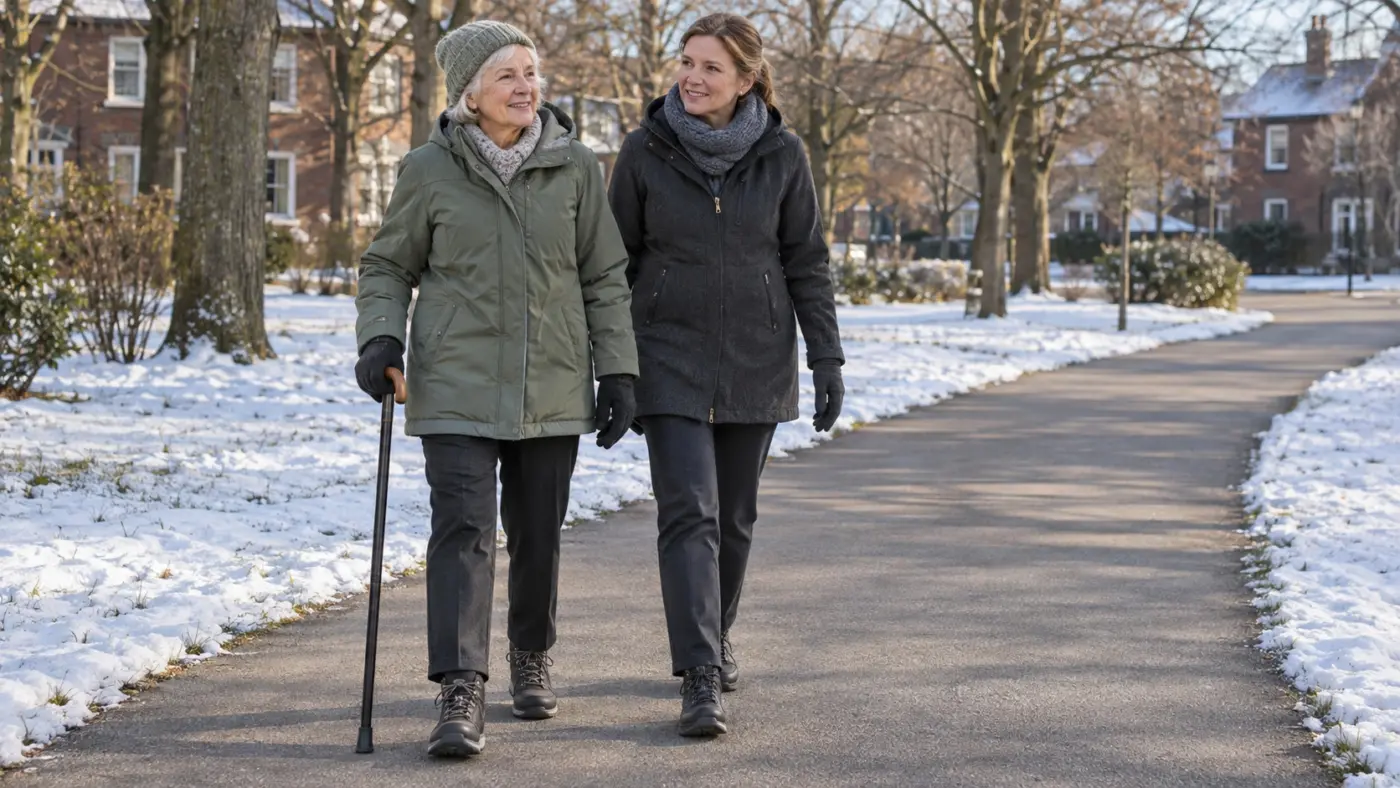
Winter Walking Safety for Older Adults: When to Go Out and When to Stay In
Winter walking safety for older adults involves balancing fall prevention with the freedom to remain active. A daily walk may provide routine, companionship, and a reason to leave the house; asking someone to stop throughout winter can feel like a loss of independence. Equally, a familiar route is not automatically suitable when cold, ice, clothing, or physical ability changes.
Many older adults can continue outdoor walks when they feel well, the route is clear, and the outing can be adapted. When there is unavoidable ice, significant wind or wetness, reduced control of a walking aid, or concerning symptoms, postpone the walk or choose a suitable indoor alternative.
The aim is to preserve activity through flexible decisions. A shorter walk, a different time, or an indoor session can all be reasonable ways to keep moving.
Can Older Adults Walk Outside During a Cold Spell?
Yes, provided the person’s condition and the actual environment allow an appropriate outing. A cold spell should trigger a fresh assessment rather than an automatic decision based only on age or the usual schedule.
Start by choosing among three options:
| Today’s Situation | What It May Look Like | Practical Decision |
|---|---|---|
| Suitable for a modified outing | Usual walking ability, manageable weather, clear surface, reliable return | Choose a short, familiar route and review conditions along the way |
| Needs changes first | Uncertain pavement conditions, uncomfortable clothing, limited daylight, or a difficult entrance | Change the time, route, equipment, or assistance before deciding |
| Outdoor walk should be postponed | Unavoidable ice, severe weather, inability to control the aid, or concerning symptoms | Stay out of the hazardous conditions; choose appropriate indoor activity or seek medical help |
This table is a planning framework, not a clinical clearance tool. New illness or symptoms should not simply be placed in the “shorter walk” category.
A useful question is: “What would make today’s plan manageable?” If the answer requires someone to struggle across ice, hurry through traffic, or rely on a companion to prevent a fall, the outdoor plan needs changing.
Is There a Temperature Below Which Seniors Should Not Walk?
There is no single outdoor temperature that establishes safety for every older adult. Air temperature must be considered alongside wind, wetness, exposure time, surface conditions, and individual health.
The U.S. National Institute on Aging explains that older adults may have difficulty recognizing or responding to becoming too cold. Some medical conditions and medicines can also affect temperature regulation. [1]
Do not treat 0°C/32°F as a universal dividing line. Above-freezing air can coexist with frozen surfaces, while a dry, sheltered setting differs from an exposed, wet one at the same temperature.
Before deciding, check:
The current forecast and the forecast for the return journey.
Wind and precipitation, rather than temperature alone.
Ice, freezing-rain, or severe-weather warnings.
Whether the route has actually been cleared.
How quickly the person can reach a warm indoor place.
Follow local advice from the national weather service and municipality. Warning systems differ across Europe, the United States, and Canada, so one country’s color or temperature threshold should not be presented as a universal medical rule.
Why a Sunny Afternoon May Still Be Unsuitable
Sunshine improves visibility but does not prove that a pavement or sidewalk is ice-free. Inspect the walking surface and route information before assuming the weather has improved enough.
The UK Met Office explains that ground temperatures can fall below freezing even when forecast air temperatures remain above zero. Clear ice can also resemble a wet surface. [2]
For example, a bright route may still include a shaded entrance, water draining across the pavement, or an uncleared crossing. These interruptions matter more than the appearance of the sky.
If you cannot confirm a continuous usable route, choose another location. Do not ask a person who depends on a cane to test suspected ice with their body weight.
Compare Today’s Mobility With the Person’s Usual Pattern
The most useful starting point is whether the person feels and moves as they normally do. Yesterday’s distance, a neighbor’s pace, or a step-count target cannot establish today’s readiness.
Before dressing for the walk, notice ordinary movement indoors:
Is getting out of the usual chair more difficult?
Does standing produce dizziness or unusual weakness?
Are steps more hesitant, uneven, or tiring than usual?
Is more support needed from furniture or another person?
Can the person handle their cane comfortably?
Has there been a recent fall, illness, medication change, or interruption to normal activity?
These are observations to guide a decision, not a home diagnostic test. Do not ask an unsteady person to perform repeated unsupported transfers to prove they can go out.
A person may feel disappointed about postponing a walk. Explain the specific concern and offer a workable alternative: “Your steps feel less steady today; let’s keep movement indoors and ask for advice if that continues.”
If the change is substantial, sudden, or accompanied by warning symptoms, seek medical assessment. A coat, new cane tip, or helping arm cannot resolve an unexplained change in walking ability.
Assess the Whole Journey, Including the First Few Metres
A winter route is suitable only if the person can reach it and return without an unavoidable hazardous section. The front step, car park, and entrance may be the most difficult parts of an otherwise clear outing.
Check the entire sequence:
Leaving the seat and reaching the door.
Putting on shoes and collecting the walking aid.
Crossing the threshold or steps.
Reaching the pavement, vehicle, or transport stop.
Completing the chosen walking section.
Returning through the entrance and removing outdoor equipment.
A well-maintained park does not help if reaching it requires crossing an icy driveway. Similarly, an indoor walking venue may be unsuitable that day if the car park and approach are untreated.
Consider who can check the route beforehand. A family member, venue employee, or local service may be able to confirm access, but yesterday’s report may no longer reflect today’s weather.
Treat uncertainty as a reason to simplify the plan. A closer destination with clear access can be more useful than a longer, attractive route with one difficult connection.
What Winter Surfaces Deserve Particular Caution?
Ice, compacted snow, hidden unevenness, and wet transitions can make familiar walking surfaces unpredictable. A route should be selected for its current condition rather than its usual reputation.
Different winter settings create different problems:
| Surface or Situation | Main Concern | Better Planning Response |
|---|---|---|
| Clear or “black” ice | May look wet rather than frozen | Avoid the affected section; use an alternative route |
| Compacted snow | Uneven or slippery footing | Prefer a cleared, maintained surface |
| Fresh snow over unknown ground | Concealed edges, holes, or ice | Avoid assuming that a smooth white surface is level |
| Meltwater after a freeze | Conditions may change across the route | Recheck the surface and expected return conditions |
| Wet leaves and sloping paving | Unreliable contact beneath shoes and cane tips | Choose a clearer, flatter route |
| Indoor entrance after snow or rain | Water, slush, and floor mats | Pause at a secure transition point before continuing |
Reducing speed can help with observation, but it does not make an unsuitable surface acceptable. Do not turn “take small steps” into permission to cross ice that could be avoided.
If the route becomes unsuitable after departure, stop in a secure place and arrange an alternative. Do not continue simply because the destination appears close.
Choose Daylight, Shelter, and Easy Return Over Distance
The best winter walking time is the period when actual conditions are most manageable and there is enough time to return before visibility or weather deteriorates. Late morning or early afternoon may work, but they are not guarantees.
Avoid treating an established early-morning routine as a requirement. Waiting for a maintained route to be cleared can be a sensible adjustment.
Look for:
A short route with several opportunities to return.
Level, visible walking surfaces.
Shelter from strong wind.
Accessible indoor rest points.
Toilets when needed.
Crossings that do not require rushing.
A realistic return option if the outing ends early.
Check that planned rest stops are open. A closed café or locked community building cannot serve as a warming point simply because it usually does.
Rest also needs context. Sitting outside for a long period can extend cold exposure. If a person needs frequent lengthy stops, a heated indoor venue may be more appropriate than a route with outdoor benches.
Plan the return before departure. The person may be colder and more tired on the way back, even if the outward journey felt easy.
How Far and How Fast Should an Older Adult Walk in Winter?
Choose a distance and pace that leave room for an early return. A winter outing should not become a test of whether someone can reproduce a summer route.
For example, someone who usually completes a long circuit might choose a brief out-and-back section near home. This is an illustration of flexible planning, not a prescribed duration.
Useful adjustments include:
Begin with an easier option than the person’s usual maximum.
Allow extra time for entrances, crossings, and changing equipment.
Slow down before turns and surface changes.
Keep the pace comfortable for the person using the aid.
Turn back before fatigue makes placement of feet or cane inconsistent.
Stop treating a planned distance as an obligation once conditions change.
Discuss the stopping point in advance. “We can return whenever you want” is helpful, but a concrete agreement is easier to act on: “We will reassess at the corner before continuing.”
A companion should not keep extending the route with “just a little farther.” The useful outcome is a manageable outing that the person is willing to repeat, rather than a completed route followed by exhaustion.
Cold-Weather Walking Is Different From Snow Clearing
A gentle walk should not be combined casually with shoveling or pushing through deep snow. These tasks can involve a substantially different physical demand.
The American Heart Association warns that sudden exertion in cold weather, including heavy snow shoveling or walking through heavy snow, can strain some people’s hearts. People with cardiovascular concerns should discuss appropriate cold-weather activity with their clinician. [3]
Arrange help with access if clearing is needed. Do not make clearing the path a warm-up task for someone whose mobility or health already makes winter walking difficult.
Dress for Warmth Without Losing Movement or Visibility
Winter clothing should provide warmth and weather protection while allowing controlled walking and cane use. More bulk is not automatically better.
Check the complete outfit while indoors:
Can the arms move comfortably?
Does the coat interfere with the hand holding the cane?
Are trouser hems clear of the ground and shoes?
Are loose scarves and cords secured?
Can the person see down toward approaching surface changes?
Can pockets, fastenings, and the phone be managed?
Can outdoor layers be adjusted without an awkward unsupported reach?
The National Institute on Aging recommends warm layers, protection for the head and hands, and suitable outerwear for wet conditions. Damp clothing should be changed promptly. [1]
The practical challenge is often the combination. A warm coat may work well until a thick sleeve meets a bulky glove and prevents comfortable use of the handle.
Try the actual clothing rather than judging each item separately. If dressing requires considerable effort, allow time to recover before deciding whether to leave.
Choose Footwear for Fit, Control, and the Intended Surface
Winter footwear should fit securely, remain manageable to put on, and suit the surface being considered. A deep tread pattern or “winter” label alone does not guarantee grip on ice.
When trying boots, use the socks normally worn with them. Check whether the heel stays secure and whether the foot can be positioned without the boot catching the other shoe or cane.
Also consider:
Whether fastenings can be operated reliably.
Whether the boot feels unusually heavy to lift.
Whether the sole or heel is worn unevenly.
Whether the person can feel and judge foot placement.
Whether the boot changes the usual standing position.
New footwear should first be tried on a dry, level surface with the person’s normal support. Do not introduce unfamiliar boots for the first time at an icy doorstep.
People with reduced sensation, foot problems, or prescribed footwear may need professional guidance before changing shoes or adding accessories. Fit and skin protection remain important even when traction is the immediate concern.
If the only available route is unsuitable for the footwear and person, change the route. Shopping for a more aggressive sole is not the only response.
Do Ice Cleats and Cane Ice Tips Make Winter Walking Safe?
Compatible traction accessories may help on specified winter surfaces, but they do not establish that a route is suitable for a particular person. They also create a transition task when entering a building.
Canada’s Public Health Agency advises that cane spikes should be raised or removed indoors and that detachable studded soles should be removed on indoor floors, where they can slip. [4]
Before using an accessory, confirm:
It is compatible with the exact footwear or cane.
It can be fitted securely.
The user can manage it or has appropriate assistance.
There is a stable place to put it on and remove it.
The manufacturer’s surface and use instructions are understood.
The original footwear or cane remains controllable afterward.
Do not assume that a larger ice attachment is better. Added size and weight may change how the cane moves or how close it passes to the shoes.
A particularly important question is: “What happens at the shop entrance?” If removal requires balancing on one leg or bending while standing on a wet floor, the accessory plan is incomplete.
Traction equipment should support an appropriate route choice, rather than justify an otherwise unsuitable outing.
Check the Walking Cane With the Winter Outfit On
A cane should be inspected as a complete aid, then tried with the gloves and shoes planned for the walk. Winter changes at the hand and foot can affect a previously familiar setup.
Check:
A secure handle without cracks or unusual rotation.
An intact, correctly fitted rubber tip.
A shaft without damage or deformation.
A height-setting button fully engaged, where applicable.
A tightening collar secured according to the instructions.
Fully seated joints on a folding cane.
Straps and clothing that do not catch or interfere.
A comfortable working height with the chosen footwear.
If a folding mechanism or height lock does not function normally, stop using the cane and contact the supplier.
For the relationship between folding joints and height adjustment, see DEERMED’s folding adjustable walking cane guide.
A self-standing base provides parking convenience in appropriate conditions; it should not be treated as an ice-gripping feature or proof that the aid offers the same support as a walker.
Gloves Must Allow Reliable Control
The right glove is one that keeps the hand adequately protected while allowing the user to control the handle. Warmth and grip need to be assessed together.
Try lifting, placing, and turning with the cane on a dry indoor surface. Notice whether the handle rotates inside the glove or whether extra squeezing is needed.
If control changes, compare glove fit, thickness, and palm material before assuming the cane needs replacement. Avoid improvised loose handle coverings that can rotate or conceal damage.
Persistent numbness, pain, weakness, or loss of control needs assessment. Do not dismiss these symptoms as an unavoidable part of winter.
Treat Entrances as Part of the Walk
The change from outdoor paving to an indoor floor deserves a deliberate pause. Snow and water on footwear or a cane tip can travel indoors even when the building itself is warm and dry farther inside.
Plan a place where the person can remain supported while:
Opening or passing through the door.
Removing traction accessories as instructed.
Managing a wet coat or umbrella.
Checking for slush on the cane tip and soles.
Moving across a flat, secured entrance mat.
Do not rush because other people are waiting. A companion can hold the door or manage a bag while the cane user concentrates on the transition.
If an umbrella occupies the free hand and catches the wind, reconsider the arrangement. Suitable outerwear, a sheltered route, postponement, or practical assistance may be preferable.
At home, keep the aid accessible during undressing. A cane put away too early can leave someone searching for support while still wearing wet or unfamiliar boots. See where to keep a walking cane at home for placement principles.
What Should Replace an Outdoor Walk When Conditions Are Poor?
Use a suitable indoor activity rather than treating a canceled outdoor walk as a requirement to remain seated all day. The replacement should match the person’s ability, preferences, and available support.
Possible settings include:
A clear, well-lit route within the home.
An accessible community or senior centre.
A maintained indoor walking track.
A shopping centre with appropriate access and rest points.
A familiar, professionally advised home exercise routine.
Check the journey to the venue as carefully as the activity inside it. An indoor destination is not a complete solution if reaching it requires crossing an icy car park.
At home, remove obstacles rather than repeatedly weaving around furniture. Avoid creating a walking circuit through loose rugs, trailing cables, pets, or narrow turns.
If the person needs a cane indoors, use the prescribed aid. Do not remove it to make an exercise appear more demanding.
An Example of an Adaptable Indoor Day
Several comfortable opportunities to move may be easier to arrange than one long session. The example below illustrates planning choices, not an exercise prescription.
| Part of the Day | Possible Activity | Check Before Starting |
|---|---|---|
| After breakfast | A brief walk along a clear indoor route | Normal walking aid available; no dizziness |
| Later in the morning | Familiar seated movements or prescribed exercises | Suitable chair and established technique |
| Afternoon | Indoor walking or an accessible class | Safe access, supervision if needed, and rest options |
| During long seated periods | Change position or take a suitable movement break | Assistance available when required |
Someone recovering from surgery or living with significant balance difficulties should follow their individual programme. A generic list cannot determine which standing or resistance exercises are appropriate.
The useful habit is having an alternative ready before the weather deteriorates. Otherwise, the choice may feel like “go out or do nothing.”
How Do Winter Walks Fit Into Weekly Activity Goals?
Weekly activity guidance is a long-term framework, not an instruction to walk outdoors regardless of conditions. Walking is also only one part of a balanced activity routine.
The CDC recommends that adults aged 65 and older include aerobic activity, muscle-strengthening activity, and balance activity. Its general guidance includes at least 150 minutes of moderate aerobic activity weekly and strengthening on at least two days, while advising people to be as active as their abilities and conditions allow. [5]
A relaxed stroll may be valuable without reaching moderate intensity. Do not count every minute of gentle movement as equivalent exercise, but do not dismiss it because it does not meet a particular intensity.
For someone below the general target, a realistic plan may begin with smaller amounts and professional advice. Missed minutes do not create a debt that must be repaid by a longer walk in poor weather.
Indoor walking, prescribed strengthening, and suitable balance work can contribute different things. Ask a clinician or qualified exercise professional how they fit together for the individual.
How Can Families Help Without Taking Over?
Support works best when the older adult participates in the decision and retains control of the pace. Discuss the day’s specific conditions rather than using age as the reason to refuse an outing.
Useful questions include:
“How do your legs and hands feel today?”
“Would you prefer a shorter outdoor walk or the indoor route?”
“Where should we reassess before continuing?”
“Would you like help with the door or the bag?”
“What would make coming home easier?”
A companion can check access, carry practical items, and help communicate a change of plan. Being present does not make an icy surface suitable or replace trained assistance when substantial physical support is needed.
Avoid grabbing the cane or pulling the person’s arm unexpectedly. If hands-on assistance is regularly necessary, ask a therapist to teach an appropriate method.
A cane’s appearance and comfort can influence willingness to use it. Respect those preferences while confirming that its fit and support level remain appropriate. Independence includes choosing help, changing plans, and deciding to stop.
Agree on Stopping Rules Before Leaving
A walk is easier to adapt when the reasons to stop are clear in advance. Cold hands, changing footing, or increasing fatigue should prompt reassessment before the return becomes difficult.
Agree to stop or change the plan if:
The route becomes icy, obstructed, or poorly visible.
Clothing or gloves become wet.
The person cannot control the cane normally.
Walking becomes noticeably less steady.
Rest is needed more often than expected.
Weather changes make the planned return uncertain.
Carry a charged phone in an accessible pocket, not at the bottom of a bag. Know whom to contact and where a secure indoor waiting place is available. Do not rely on a bench, stranger, or taxi appearing at the right moment.
Turnaround planning is especially useful for people who dislike abandoning a goal. Agreeing beforehand makes returning a planned option rather than an argument in the cold.
Which Symptoms Need Medical Help Rather Than a Shorter Walk?
Concerning symptoms should be assessed rather than managed by simply reducing the distance. Sudden or severe illness requires urgent help; recurrent mobility problems deserve professional review.
Seek emergency assistance for collapse, severe breathing difficulty, concerning chest pain, sudden facial drooping or one-sided weakness, or sudden speech difficulty.
Confusion, slurred speech, marked drowsiness, fumbling hands, and exhaustion after cold exposure can indicate hypothermia. The CDC describes hypothermia as dangerous and notes that it can occur even above 40°F—about 4°C—when someone becomes chilled by rain, sweat, or cold water. [6]
If hypothermia is suspected:
Contact local emergency services promptly.
Move to shelter if this can be done safely.
Replace wet clothing and use dry coverings while following emergency instructions.
Do not require the person to walk home to “warm up.”
Do not give a drink to someone who is drowsy or unable to swallow safely.
Do not assume confusion is ordinary tiredness, or diagnose slurred speech at home as “just the cold.”
Arrange non-emergency assessment for repeated near-falls, ongoing difficulty rising, persistent hand symptoms, or an increasing need to lean heavily on a cane. Winter may reveal a support problem that also needs attention on dry indoor ground.
What If Someone Falls During a Winter Walk?
Stop the activity and assess the need for help before attempting to move the person. The priority is injury assessment and protection from further exposure, not finishing the route.
The NHS advises emergency help when a person cannot get up or may have injured the head, back, neck, or hip, and warns against trying to lift a fallen person yourself. [7]
Keep them warm and comfortable while following emergency advice. Do not force a painful limb to bear weight or use the cane as a lever to pull them upright.
A head impact needs particular attention when the person takes blood-thinning medication. Seek prompt medical advice rather than judging the situation only by the absence of a visible wound. [8]
After a less serious incident, review the surface, footwear, equipment, fatigue, and circumstances. A near-fall is also useful information. Avoid reducing the explanation to “they were careless” or assuming a new accessory will solve every contributing factor.
DEERMED’s View: Keep Activity Flexible and Equipment Claims Realistic
A useful winter plan connects the person, the walking aid, and the environment. Good construction and maintenance matter, but a cane cannot remove ice, restore visibility, or determine whether someone is medically ready to walk.
From a design and manufacturing perspective, the practical questions are whether the aid can be gripped, positioned, checked, and maintained. Winter clothing and accessories need to work with those tasks.
The same principle applies to the activity plan. Choose a route with clear access, leave room to return early, and keep a suitable indoor option available. Before the next cold spell, agree on one manageable outdoor route and one indoor alternative.
The aim is continued participation with room to adjust. Choosing a different activity today can help preserve confidence in being active again tomorrow.
This article provides general winter activity and walking-aid information. It does not replace individual medical advice, rehabilitation guidance, or an assessment of walking-aid suitability.
Frequently Asked Questions
Winter walking decisions often involve more than the forecast. These answers address practical questions about zero-degree weather, companions, accessories, indoor activity, and changing confidence.
Is 0°C or 32°F automatically too cold for an older adult to walk outside?
No single temperature provides an automatic answer. At 0°C/32°F, the condition of the route, wind, moisture, clothing, exposure time, and personal health all matter.
A clear path does not eliminate cold-exposure concerns, and an above-freezing forecast does not prove the ground is ice-free. Follow local warnings and any individual medical advice. If the route cannot be confirmed suitable, choose an indoor option rather than using the thermometer as permission to go out.
Is a short winter walk worthwhile if I cannot manage my usual distance?
Yes. A manageable outing can preserve a valued routine without requiring the usual route or duration. Decide what is comfortable today and retain enough capacity for the return.
Shorter activity should not mean ignoring symptoms or walking on an unsuitable surface. If outdoor access is the main problem, an indoor session may be a better choice. If even a brief walk is becoming unusually difficult, discuss the change with a healthcare professional rather than repeatedly reducing the route without assessment.
Can I use trekking poles instead of my prescribed walking cane in winter?
Do not assume they are interchangeable. Trekking poles, Nordic walking poles, canes, and walkers have different designs and intended uses.
If a cane has been selected for a mobility problem, discuss a proposed change with the clinician or therapist involved. Adding a second pole or a pointed tip does not automatically provide the same support or technique. Any new aid should be fitted and practised in appropriate conditions before it becomes part of an outdoor winter routine.
Is walking with a family member enough to make an icy route acceptable?
No. A companion can assist with planning, doors, communication, and carrying items, but cannot guarantee recovery from a slip.
Choose a route that is appropriate without depending on someone to catch the walker. If substantial physical support is required, ask a therapist about the walking aid, assistance method, and environment. On unavoidable ice, postponement or a different destination is generally more sensible than assuming that two people together can manage the hazard.
Should I use a treadmill when the pavement is icy?
A treadmill may suit some people, but its moving belt, starting and stopping controls, and access requirements introduce different challenges. It is not an automatic substitute for someone who needs a cane or has balance difficulties.
A level indoor route may be easier to arrange. If treadmill exercise is being considered for rehabilitation or a person with significant mobility limitations, obtain individual guidance and appropriate supervision. Do not place a cane on a moving belt as an improvised solution.
Do winter boots mean I need to change my cane height?
They may change the relationship between the handle and the body, but a height adjustment should not be automatic. Try the boots with the cane on a dry, level surface and assess the actual fit.
If the cane was fitted by a therapist, ask before making a substantial change. After any permitted adjustment, confirm that the positioning mechanism is fully engaged and the cane remains secure. Do not choose a different height merely to compensate for footwear that is difficult to control.
What if fear of falling keeps me indoors throughout winter?
Acknowledge the concern and identify the specific situations that feel difficult. A clear indoor walking route, a suitable supervised class, or an assessed outdoor route may provide a manageable starting point.
Avoid forcing an outing to prove that the fear is unfounded. Persistent fear, repeated near-falls, or increasing inactivity deserves discussion with a healthcare professional. The goal is a plan that rebuilds participation at an appropriate level, with the person involved in choosing it.
Should I drink less before a winter walk to avoid needing the toilet?
Do not deliberately restrict fluids simply to complete the route. Plan an outing with suitable toilet access and follow any existing medical advice about fluid intake.
People with heart, kidney, or other conditions may have individual fluid limits; those instructions take priority over generic hydration advice. If toilet urgency repeatedly makes outings difficult, raise it with a healthcare professional and adjust the route or timing rather than making dehydration part of the walking plan.