
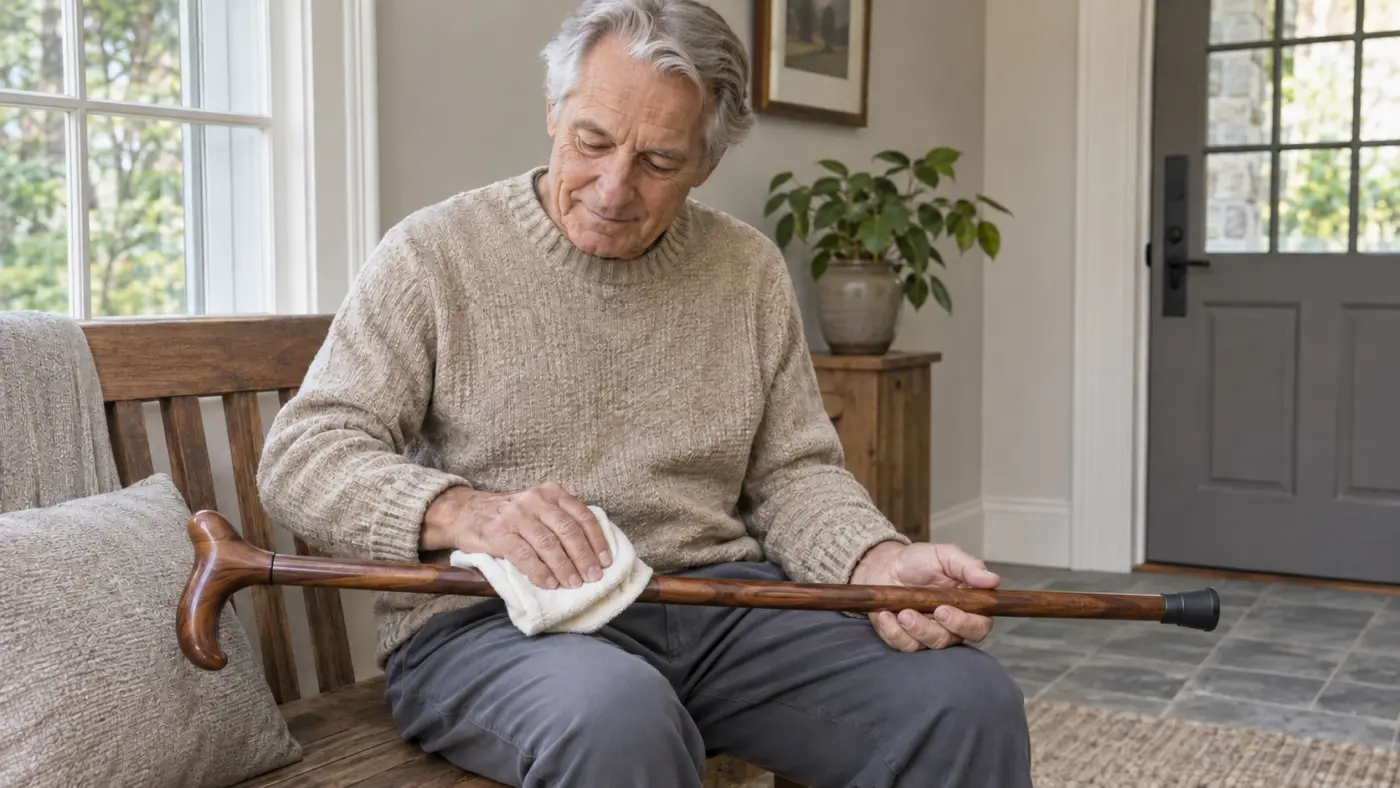
How to Care for a Wooden Walking Cane: Cleaning, Rain, and Storage
A wooden walking cane that feels familiar and suits your style can be easier to make part of everyday life. For older adults and their families, keeping that cane in good condition is one part of fall prevention, alongside suitable support and a clear walking route. Start with a soft, dry cloth. Use a barely damp cloth only if the finish permits it, dry the cane promptly, and look over the handle, shaft, and rubber tip before relying on it again.
Picture coming home from a wet walk. There is grit on the tip and water around the metal collar beneath the handle. A quick wipe of the shaft will take care of the visible droplets, but the collar and the top edge of the rubber tip deserve a look too. Those areas are easy to miss, especially when the cane goes straight into the umbrella stand.
This guide is for wooden walking canes and walking sticks used as everyday mobility aids. If your cane has a wooden handle on a metal shaft, check the instructions for both materials and for any decorative fittings.
What Should You Check Before Cleaning a Wooden Cane?
Look at the handle attachment, shaft, and rubber tip before applying any cleaner. If you see a split in the wood, a change in the shaft’s shape, or a handle that shifts at its connection, set the cane aside and ask the supplier to assess it.
Sit securely or have another suitable source of support available while you inspect the cane. In good light, look along the shaft from several angles. Examine the wood immediately below the handle and near the bottom of the shaft. On canes with a separately fitted handle, look for a new gap, offset, or movement that was apparent during normal use. A cane carved from one piece can still develop damage around the curve of the handle or the base of the shaft.
Check the finish as well. Dust and fingerprints usually call for routine cleaning. A cloudy patch, lifted finish, or sticky grip calls for a closer look before applying more water or a different cleaner. Note any recent drop, impact, or water exposure when you contact the supplier.
How Do You Clean a Wooden Walking Cane?
Use a soft, dry cloth for routine dusting. For marks that remain, use a well-wrung cloth only if the manufacturer allows damp cleaning, then dry the surface immediately.
Lift away dust and loose grit. Use a soft cloth on smooth surfaces and a soft, dry brush in accessible decorative grooves. Grit caught in the cloth can scratch the finish as you wipe.
Check the finish instructions. A glossy handle may be coated, and a matte shaft may still have a protective finish. When the finish is unknown, start with dry dusting and ask the supplier about stubborn marks.
Wipe permitted areas sparingly. Apply moisture to the cloth, keeping it barely damp. Wipe small areas and keep liquid away from openings, joint lines, and the edge of the rubber tip.
Use a mild cleaner only if approved. Follow the specified amount and remove residue as directed. Avoid abrasive pads, steel wool, and household solvents on an unfamiliar finish.
Dry with a second soft cloth. Pay attention to the underside of the handle, around any collar, and where the rubber meets the shaft.
Check the grip and contact surface before use. Both should be dry and free of slippery residue. Ask for advice if the finish becomes cloudy, sticky, or starts transferring onto the cloth.
The Canadian Conservation Institute describes how some wood finishes are sensitive to water and explains why moisture should be used sparingly on suitable finishes. For a walking cane, use that principle alongside the product’s own care instructions. Worcestershire Acute Hospitals NHS Trust also cautions against bleach and solvents in its guidance for walking aids. [1][2]
How Do You Clean a Wooden Handle That Feels Sticky?
Start by checking whether the stickiness comes from surface residue or a deteriorating finish. Hand cream and everyday grime may respond to the approved cleaning method. A coating that stays tacky, sheds color, or flakes after wiping needs supplier advice.
Support the cane while cleaning underneath the grip, where residue can collect out of sight. Avoid wrapping a loose or flaking handle in tape to make it easier to hold. A cover can obscure the point where the handle meets the shaft, making it harder to notice changes later.
If disinfection is required, ask the manufacturer or equipment provider for a compatible procedure. Routine cleaning and disinfection serve different purposes.
Should You Oil, Wax, or Polish a Wooden Walking Stick?
Use oil, wax, or polish only when the product’s finish and care instructions call for it. There is no general oiling schedule for wooden walking sticks, even when two canes are made from the same wood.
A lacquered shaft, an oil-finished handle, and a stained cane with a clear topcoat can react differently to the same product. Shine alone provides little information about the coating. This matters with vintage or second-hand canes, where the original finish may also have been changed by a previous owner.
Some furniture polishes leave a buildup and can complicate later finish work, as the Canadian Conservation Institute explains. On a cane, also consider what the product leaves where you hold it. An oily or waxy surface can change how the handle feels and how easily you can control it. [1]
If a supplier specifies a finish treatment, follow its instructions about where to apply it and when the cane can return to use. If you mainly want to remove a mark, describe the mark and the finish before buying a treatment. Keeping a few signs of everyday use may be preferable to repeatedly sanding or polishing the surface.
What Should You Do If a Wooden Cane Gets Wet?
Blot surface water, remove grit from the rubber tip, and let the cane dry at room temperature in a ventilated place. Check the handle joint, shaft, and tip again before putting it back into service.
After rain, sleet, or a walk on treated winter pavements:
Set the cane down securely while seated or using suitable alternative support.
Blot water from the handle and shaft with a soft, dry cloth.
Clear visible mud, grit, or road-salt residue from the tip using the approved cleaning method.
Dry accessible areas around the handle joint, collar, and shaft end. Ask the supplier how to deal with trapped moisture if the fitting would need to be removed.
Let the cane air-dry away from radiators, heating vents, and direct sun. Give it time to dry before placing it in a sleeve or closed bag.
Look again for a new split, swelling, distortion, looseness, or a tip that sits at an angle.
Wood exchanges moisture with the surrounding air and can change dimensions as its moisture content changes. Appropriate handling and storage help limit that movement. [3]
A few drops from a short walk are a different situation from a cane left standing in water. If the cane was submerged, the wood has changed shape, or the handle moves, contact the supplier before relying on it. A dry surface alone gives little information about moisture or damage around a joint.
Snow and slush can also leave the rubber tip wet just as you step onto smooth indoor flooring. If the entrance is slippery, use a secure place to pause and deal with the wet equipment. For advice on planning the route itself, see Winter Walking Safety for Older Adults.
How Can You Tell Wood Grain From a Crack?
Look for a physical opening, a change in the line over time, or movement at a nearby joint. Natural grain can be dark and prominent. If you are unsure whether a line extends into the wood, pause support use and have the cane checked.
| What You Notice | What to Look For | What to Do |
|---|---|---|
| Dark line following the grain | Smooth surface with no apparent opening or recent change | Observe during routine care |
| Fine surface scratch | Mark appears confined to the finish, with no impact or movement | Keep it clean and check for changes |
| Clouding, bubbling, or flaking | Visible change in the coating | Pause finish treatments and ask the supplier |
| Suspected split | New or growing line, visible gap, or damage near a joint or the shaft end | Stop using the cane for support and arrange assessment |
| Handle movement or a new gap | Rotation, shifting, or separation at the attachment | Stop support use and contact the supplier |
Compare the mark under good light and take a close-up and a full-length photograph. If the cane was trapped under luggage or struck by a door, tell the supplier even if the mark looks small. A photograph can help identify the area, while the supplier may still need to examine the cane in person.
Leave the suspected split undisturbed. Probing it with a tool, twisting the handle, or leaning onto the cane to see whether the line opens can worsen the problem. Leave sanding, filling, and refinishing until its condition has been assessed.
When Should You Replace the Rubber Tip?
Inspect the underside of the rubber tip, also called a ferrule, and replace a worn or damaged tip with a compatible part once you have confirmed that the wooden shaft end is sound. A tip can look intact from the side while its contact surface has worn unevenly.
MedlinePlus recommends daily checks of cane tips and replacement when they are worn. NHS guidance also calls for checking loose handles and worn or split ferrules. [2][4]
Look for splits, flattening, an angled contact surface, debris, and movement where the tip meets the wood. If the tip comes loose, check whether the shaft end has chipped, split, or changed shape. A new ferrule fitted over damaged wood leaves the underlying problem unresolved.
Wooden shafts can taper, so check the fit at the point where the new tip actually seats. Confirm the exact part, insertion depth, and fitting method with the manufacturer or retailer. If the tip is too tight or sits crooked, have the fit checked before using the cane. Avoid sanding the wood or adding tape to force a fit.
For the broader inspection routine and tips on replacing a user-serviceable ferrule, see Walking Cane Maintenance.
Where Should You Store a Wooden Walking Cane?
Keep it in a dry, ventilated place away from direct heat, prolonged sun, and damp items. If you use the cane daily, choose a stable spot within reach that leaves your feet and walking route clear.
A holder that keeps the cane from sliding can work well. For a spare cane, a supported shelf can also work if the cane cannot roll, fall, or have heavy items stacked on it. Check the full length of the cane when choosing a spot, particularly the base near the floor and the handle near doors or furniture.
Common places to reconsider include:
An umbrella stand that collects water from wet umbrellas.
A boot tray where slush and road grit accumulate.
The area beside a radiator, fireplace, or hot-air vent.
A sunny window or a car where the cane may be left for long periods.
A storage bag that stays closed while the cane is damp.
Agree with family members or caregivers on a place to return the cane after cleaning. A spot beside the usual chair can be practical if the user can reach it without twisting and the tip stays out of the first-step area. See Where to Keep a Walking Cane at Home for room-by-room examples.
When Does the Person Need a Different Kind of Support?
A well-maintained single-point cane may suit someone who needs a small amount of help with walking or balance. If the person regularly needs another handhold, puts substantial weight through the cane, or has repeated falls or near-falls, ask a clinician or therapist to review the aid and the level of support needed. [4]
Even when the wood, handle, and tip are sound, persistent palm pain, numbness, or difficulty controlling the cane deserves attention. An assessment can consider grip shape, cane height, walking technique, and whether a different aid would be appropriate.
Choose a dry, well-lit route for everyday walking. If a route involves unavoidable wet tiles, ice, or slippery steps, consider a different route or suitable assistance. A replacement tip restores the intended contact surface of a sound cane. Conditions underfoot still matter.
This guide provides general care information. For advice on individual balance, mobility, or rehabilitation needs, consult a doctor, physical therapist, or occupational therapist.
What to Do at Your Next Clean
Set the cane across your lap or on a stable surface while seated. Start at the handle and work down to the tip, taking a moment to look at each connection as you wipe it. If you find an unfamiliar mark, photograph it before applying any treatment and note what happened before you noticed it.
If you need advice on a DEERMED cane, share the model, a full-length photo, and a close-up of the area in question. Include whether the cane was soaked, dropped, or exposed to a new cleaning product. Contact DEERMED.
Frequently Asked Questions
Can you use furniture polish on a wooden walking cane? What should you check if the handle feels loose or you’ve been given a secondhand cane? The answers below explain what to look for and when to check the manufacturer’s care instructions.
Can I use alcohol wipes on a wooden walking cane?
Use them only if the manufacturer approves them for the specific finish and the other surfaces the wipe will touch. If you need to disinfect the cane, ask for the compatible agent, application method, and contact time. For everyday dust, a soft, dry cloth is usually the simplest starting point.
Can I use olive oil or another kitchen oil on a wooden walking stick?
Keep cooking oils off the grip and shaft unless the cane maker specifically identifies that treatment. The right product depends on the existing finish. If you have already applied oil and the grip feels slick, set the cane aside and ask the supplier how to remove the residue without damaging the finish.
What if a white patch appears after I wipe the cane?
Stop applying cleaner and let the surface dry at room temperature. Photograph the patch and tell the supplier what touched the surface. Clouding may be confined to the coating, but swelling, a new gap, or movement at the handle needs assessment before the cane is used for support.
Can I refinish a second-hand wooden walking stick?
First confirm that the stick was designed for walking support and have its condition assessed if the history is unknown. Ask the maker or a suitable repair specialist which finish is appropriate. If it is a family heirloom and its suitability for support cannot be confirmed, it can still be kept for display while a fitted walking aid is used day to day.
Does a metal collar mean the handle is still secure?
The collar’s appearance alone cannot confirm the condition of the connection beneath it. If the handle shifts, the collar moves, or a gap has appeared, stop using the cane for support. A photo from the side and another from underneath the handle can help the supplier decide what to inspect.
Should I remove the rubber ferrule every time I clean the cane?
Leave it fitted for routine cleaning unless the instructions call for removal. Wipe the accessible area and inspect the underside while seated. If you suspect water is trapped inside, or the ferrule has started to move, ask the supplier how to inspect that particular fitting. Some designs need a different removal method from a simple push-fit tip.