
10 Advantages of Taiwan-Made Mobility Aids
Fall prevention for older adults requires consideration of physical ability, the surrounding environment, and whether a mobility aid is suitable for the person using it. Appearance and comfort also influence whether someone is willing to make an aid part of everyday life. For brands and distributors, product development therefore needs to address structure, operation, appearance, and maintenance, carrying user needs through from design to manufacturing.
The advantages of Taiwan-made mobility aids can be understood through coordination across specialist manufacturing, materials, product development, and ongoing supply. For a suitable project, these resources can help turn a concept into a product that can be manufactured, checked against agreed requirements, and supplied over time.
Taiwantrade’s rehabilitation and mobility aid directory includes finished products, components, and suppliers offering OEM and ODM services, illustrating the range of relevant supply resources available in Taiwan.[1] However, the presence of these resources does not mean every supplier offers the same capabilities, quality, documentation, or lead times.
The following ten advantages are discussed primarily through walking canes and walking sticks. Walkers, wheelchairs, and other mobility aids require separate assessments based on their structures and applicable regulations.
1. Specialist Manufacturing Resources Support Process Integration
Taiwan offers opportunities to source both finished mobility aids and components, allowing product development to draw on specialist manufacturing partners. The benefit depends on whether the manufacturer can coordinate these processes and take responsibility for final quality and delivery.
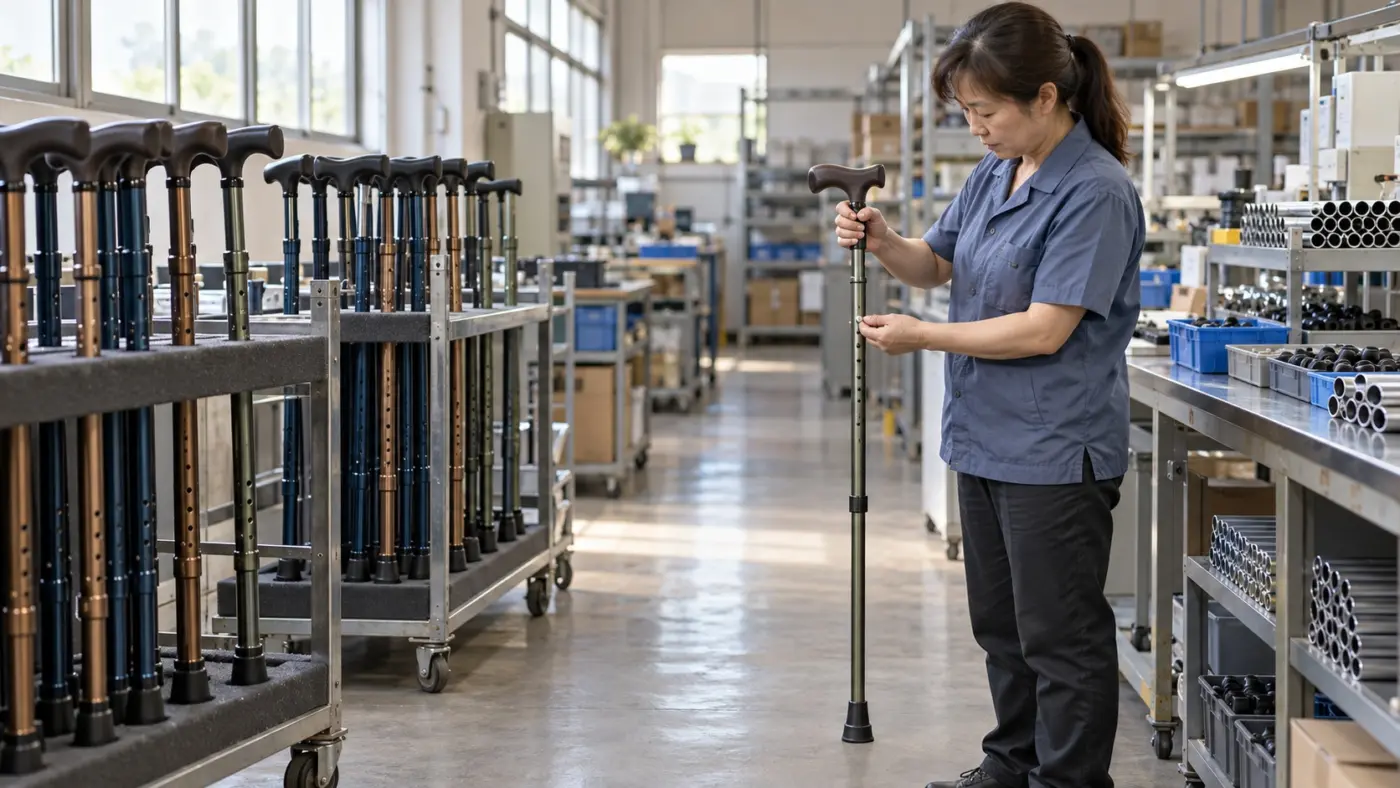
A walking cane may involve tube processing, handle production, plastic components, rubber tips, surface finishing, and assembly. These processes do not necessarily need to be performed in a single factory. Specialist partners can contribute expertise suited to each operation.
For a brand, the practical benefits may include:
Access to different processing capabilities for specific component requirements.
Coordinated discussions about how design changes affect materials, processing, and assembly.
A manufacturing contact who can manage production stages, reducing the need for the buyer to coordinate every component supplier.
Before proceeding, buyers should confirm which processes are performed in-house and which are outsourced. A large supplier network does not automatically mean effective coordination.
2. Material and Processing Options Expand Design Possibilities
Combining suitable materials and processes can help a walking stick balance feel, appearance, weight, and structure. The value lies in finding a supplier who can translate material properties into appropriate product specifications.
For example, a wooden handle, aluminum shaft, and rubber tip may all be used in the same cane, with each serving a different purpose. Material selection should be discussed alongside dimensions, attachment methods, surface finishes, and maintenance requirements.
During development, consider:
Whether the material suits the intended use and budget.
Whether dimensions and appearance can be controlled consistently after processing.
Whether different materials are compatible at their connection points.
Whether the finished product will be straightforward to clean, maintain, and service.
A material name alone does not establish product quality. Products described as aluminum or carbon fiber may perform differently because of their specifications, structures, and manufacturing processes.
3. User Needs Can Be Translated into Specific Product Features
Manufacturers with product development capabilities can translate requirements such as comfortable gripping, easy adjustment, and convenient carrying into handle, dimensional, and structural decisions. This allows brands to consider operation and manufacturing alongside appearance.
For walking canes, the user experience may be affected by handle thickness, palm contact, shaft weight, and the ease of height adjustment. DEERMED also considers grip, height adjustment, portability, and appearance preferences in its product development discussions.[2]
Ergonomic features should be evaluated through samples and user feedback:
Is the handle easy to hold, and is its surface excessively slippery?
Can a person with reduced hand strength complete the necessary operations?
Are height adjustment and locking features easy to identify?
Are different sizes or left- and right-hand versions needed?
A suitable handle may help distribute pressure across the palm, but it should not be described as guaranteed to eliminate wrist pain. Individual experiences vary.
4. Appearance and Material Choices Support Brand Differentiation
Adjustments to color, materials, and overall proportions can help brands establish a recognizable product identity while offering users choices that reflect personal preferences. These decisions should be developed alongside structural and operational requirements.
Walking sticks accompany users during commuting, shopping, social occasions, and other everyday activities. Some people prefer natural wood grain, others understated metallic colors, and others a design that complements their clothing.
Brands can develop a distinctive appearance through:
Handle shapes and surface textures.
Shaft colors and coordinated component finishes.
Logo placement and application methods.
Packaging, instructions, and product identification.
Respecting appearance preferences gives users a meaningful role in choosing their aid. However, appearance cannot replace appropriate height, secure connections, and clear use limitations.
5. OEM and ODM Services Offer Different Development Routes
Taiwanese suppliers include companies offering OEM and ODM services, giving brands options ranging from modifications to existing products to manufacturing from drawings or joint development.[1] The practical advantage is finding a route that matches the project’s investment and schedule.
| Development Route | Possible Approach | Main Trade-Off |
|---|---|---|
| Branding an existing model | Logo, standard colors, and packaging changes | More focused development work, with limited structural differentiation |
| Extending an existing design | Changes to handles, colors, or selected components | Greater differentiation, with additional compatibility and verification work |
| Manufacturing from drawings | Production to approved drawings and specifications | Design and acceptance responsibilities must be clearly defined |
| Joint development | Developing appearance and structure from a requirements brief | More flexibility, with greater development effort and time |
When market demand is still being established, it may be practical to assess whether an existing product meets the intended positioning. Dedicated components and tooling become more appropriate when a user need genuinely requires a new structure.
6. Quality Management Supports Consistency Across Production Batches
A factory with specification and process controls can provide a defined basis for product quality and repeat orders. The advantage should be demonstrated through production records and corrective actions, rather than a single attractive sample.
For the same walking cane model, handle attachment, telescopic fit, folding joint engagement, and appearance should remain within agreed requirements across batches. Clear specifications and records make differences easier to identify and investigate.
Relevant controls include:
Incoming material and critical component checks.
Production drawings and specification versions.
Assembly and finished-product acceptance requirements.
Nonconforming product and complaint handling.
Approval procedures for material or process changes.
If a supplier holds ISO 13485 certification, buyers should check the certificate holder and scope. ISO 13485 is a medical device quality management system standard; it is not an individual product’s market authorization or a guarantee of safety.[3]
7. Documentation Support Helps Prepare for Target-Market Requirements
A manufacturer that can provide relevant specifications, material information, and verification records can help buyers prepare product documentation. The value lies in accurate, traceable, and maintainable information, rather than a promise of rapid market authorization.
Requirements differ by market, intended purpose, and product classification:
In Taiwan, product status, classification, and applicable procedures must first be established.[4]
In the European Union, medical device classification determines the relevant conformity assessment route. All products should not be treated as following a single “CE certification” procedure.[5]
In the United States, FDA establishment registration and device listing do not mean that FDA has approved or certified the product.[6]
Not every Taiwanese factory can provide a complete technical documentation package, and buyers should not assume that clinical reports are available. List the required information first, then agree with the manufacturer on what is available, what additional work is needed, and who is responsible.
8. Technical Communication and Sample Reviews Help Resolve Issues Early
A manufacturing contact who can discuss materials, dimensions, and processing limitations can help identify specification gaps before mass production. Communication should be judged by whether issues are understood, documented, and resolved.
For example, a request for a lighter handle may require a discussion of materials, attachment, and grip. A larger rubber tip may require consideration of weight, ground contact, and whether it could interfere with the user’s steps.
An effective sample review can follow four stages:
Record the original requirements and unresolved items.
Identify proposed changes against the sample.
Confirm how those changes affect cost, production, and verification.
Approve the revised version before arranging subsequent production.
English proficiency and response times can be considered, but they should not be assumed to be uniform across Taiwanese suppliers. Clear technical explanations make a more meaningful difference during collaboration.
9. Component and Spare-Part Planning Supports After-Sales Service
A manufacturing partner that maintains component identification and spare-part arrangements can make maintenance and distributor support easier to manage. This extends purchasing considerations beyond delivery of the finished product.
For walking canes, replacement rubber tips require compatible dimensions. Handles, locking collars, and other parts may also differ between models. Clear identification helps reduce incorrect orders and incompatible assembly.
Confirm:
Whether spare parts have consistent identifiers and applicable model references.
Whether parts from different production batches are compatible.
Spare-part minimum order quantities, prices, and lead times.
Supply arrangements after a redesign or discontinuation.
Spare-part availability is not a permanent guarantee, and not every product is suitable for repair. Inventory and service planning should follow the actual agreement.
10. Continuous Improvement Supports Long-Term Product Development
When a manufacturer retains specifications, understands market feedback, and manages revisions, a brand can improve an existing product over time. Innovation can come from practical details without adding electronics or continually launching new models.
For everyday mobility aids, useful improvements may include:
Making height-locking features easier to recognize.
Refining handle feel or offering additional sizes.
Improving folding, carrying, or storage.
Increasing spare-part compatibility and serviceability.
Updating instructions to address recurring questions from distributors.
Additional features may also increase weight, operating steps, and maintenance demands. Each change should return to a clear user need, with an assessment of its value and any additional verification required.
What Conditions Allow These Advantages to Deliver Value?
Taiwan’s supply resources create value when the right manufacturer, clear requirements, and realistic commercial terms come together. Country of origin does not automatically guarantee low prices, short lead times, low minimum order quantities, or compliance in every market.
Keep the following considerations in view:
Dedicated components, special materials, and packaging may have minimum order quantities.
Samples, tooling, testing, and buyer approvals all affect schedules.
Materials or components may come from different regions; local sourcing should not be assumed.
Other supply options may better suit certain high-volume orders or specialized processes.
Product prices should be assessed alongside development, logistics, inventory, and after-sales costs.
“Made in Taiwan” can form part of a brand’s origin story, but the label must reflect the actual manufacturing circumstances and applicable origin requirements. The supplier’s registered business address alone does not establish product origin.
Product Quality and Individual Suitability Require Separate Assessments
Manufacturing quality and suitability for an individual user are separate considerations. Even a well-made product must match the person’s support needs and operating ability. Brands should therefore provide clear specifications, warnings, and instructions.
A cane may be suitable when someone needs a small amount of help with balance and stability. If pain, weakness, or balance problems are significant, a healthcare professional or therapist should assess whether another aid would be more appropriate.[7]
Brands and distributors should avoid:
Presenting Taiwan-made products as risk-free.
Describing ergonomic features as treatments or guarantees of pain relief.
Interpreting a weight rating as proof of suitability for everyone.
Allowing appearance or additional features to replace structural and operational assessments.
This article provides industry and product information. It does not replace an individual medical assessment.
DEERMED’s Perspective: Manufacturing Value Should Be Visible in the Details
The value of Taiwan manufacturing should be evident in product specifications, sample approvals, production arrangements, and ongoing support. These verifiable details give brands a practical foundation for long-term supply relationships.
DEERMED Inc. is a Taiwan-based manufacturer specializing in the design, development, and production of walking canes, walking sticks, and mobility aids, with OEM manufacturing and ODM development services.[2]
We begin with the product’s intended use and the customer’s requirements, discussing handles, shafts, rubber tips, and appearance before connecting approved samples with production. If specifications are not yet complete, the conversation can start with the target market, estimated quantities, and the problem the product is intended to address.
If you are planning a branded walking cane range, sourcing existing models, or considering custom development, visit the DEERMED website to discuss suitable products and manufacturing options.